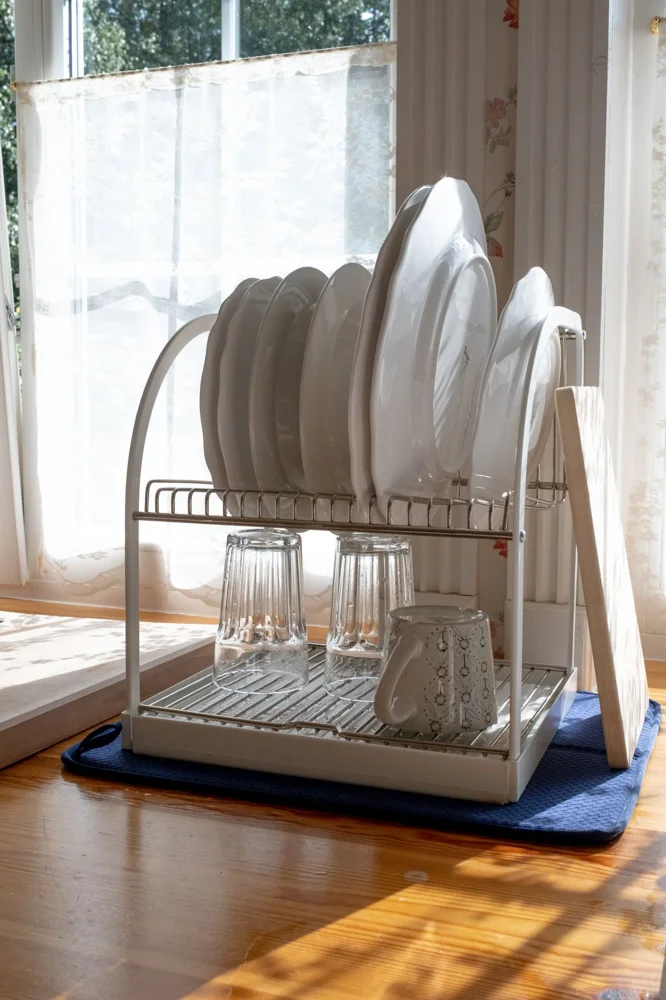
A dish rack earns its place by giving wet dishes somewhere stable to drain without taking over the only useful preparation space. In a small kitchen, the right choice starts with the sink and the dishes you wash most often. A compact rack that accommodates dinner plates and one saucepan can be more useful than a tall model advertised with an impressive place-setting count. Treat the rack, drainboard and utensil holder as one footprint when comparing dimensions.
Measure the whole wet zone
Measure the clear worktop beside the sink, including the depth available before the backsplash. Then note the height of the sink rim. A drainage spout that stops short of that rim can leave water on the counter, even when the rack itself fits. Allow room to lift a drainboard out for cleaning rather than trapping it beneath nearby appliances.
Make a paper outline of the proposed footprint and leave it in place during meal preparation. Open the tap, reach for soap and move a cutting board through the area. This simple layout check reveals interference that a product photograph tends to hide. Include any side hooks, projecting handles or removable cutlery baskets.
Choose around the awkward item
Count is less informative than shape. Wide pasta bowls may occupy several plate slots, and a saucepan lid can be difficult to balance in a rack designed around flat dinnerware. Look for photographs showing objects similar to your own, and check the distance between the supports if the seller provides it.
An over-sink rack can free the counter but uses the sink while loaded. A roll-up mat is easy to put away, although it offers less upright support for dishes. A two-tier rack creates more space above the counter; check that tall plates will clear wall cupboards and that you can reach the lower level.
Follow the water, then the cleaning route
A tray catches drips; a draining tray attempts to send them somewhere. Decide which arrangement works with your sink rather than assuming they are interchangeable. A flat tray needs emptying, and a removable mat needs somewhere to dry. Both can work when the maintenance routine is easy.
Inspect joints, feet and the bottom of the utensil cup. These are the places you will have to reach during cleaning. Prefer parts that lift apart without tools if you expect to clean them frequently. Follow the care directions for the actual finish: a metal-looking coating does not identify the material underneath.
Spend on fit rather than a larger bundle
Included hooks and extra holders are useful only if you can position them without blocking drainage or access. Compare the rack you will actually assemble with a simpler alternative. For a household that runs a dishwasher and hand-washes only a few items, a small rack with open space for a pot may be enough.
Before discarding the packaging, test the empty rack in position and check the seller's return conditions. Keep the old rack until the new one has passed the fit check. A less crowded counter is a useful outcome; buying a larger organizer to hold rarely used accessories is not automatically an improvement.
THE USEFUL TAKEAWAY
Choose the smallest arrangement that supports your normal washing-up load and lets you clean underneath it. An effective dish rack fits the counter, accommodates your awkward items and has a drainage routine you can maintain. Extra tiers are worthwhile when they solve those needs, rather than simply increasing the advertised capacity.
Further information
Manufacturer and official references for the details discussed. Check instructions for the exact product you are considering.