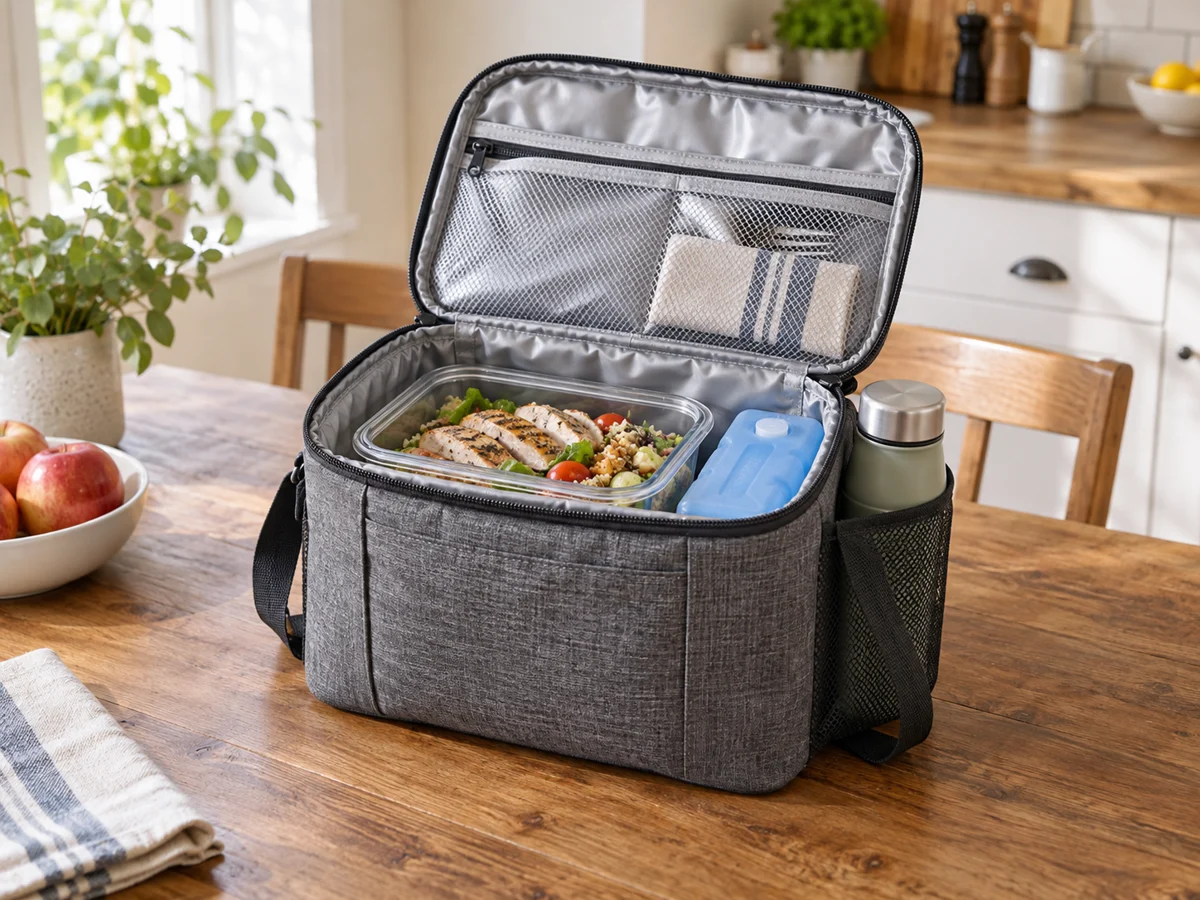
A lunch bag should be chosen around the containers you pack, rather than an advertised number of cans. A broad food box, a piece of fruit, and a reusable cooling pack occupy space differently from matching drink cans. The daily route matters too: walking with a backpack creates different carrying needs from taking a bag straight from a car to an office refrigerator. Build a realistic sample lunch first. It reveals the bag shape, opening, and handles you need more reliably than capacity alone.
Arrange a complete lunch on the counter
Put the usual containers together with cutlery and any cooling packs you plan to use. Measure the outside dimensions of the largest box, including clips. An insulated wall makes internal space smaller than the bag's exterior suggests, and a curved top can reduce usable height. Check the opening width as well as the interior dimensions. A bag that technically contains the box is frustrating if you have to tip it sideways each time you load or remove a meal.
Choose a carrying arrangement for the journey
Short handles are convenient between a kitchen and a car but may be awkward on a long walk. A shoulder strap frees a hand, although its attachment points and adjustment range deserve inspection. If the lunch bag goes inside a backpack, avoid paying for bulky external pockets that consume space without helping. A flat base can make the bag easier to set down on a desk. Check how it behaves when only one container remains inside for the trip home.
Assess insulation without assuming a guarantee
An insulated bag is a container, not an active refrigerator. Compare the manufacturer's use instructions, cooling-pack requirements, and care information for the actual product. Published holding claims depend on particular conditions and should not be transferred to every meal or commute. If you transport perishable food, follow the relevant food-storage guidance for the food and journey. For shopping purposes, focus on room for the prescribed cooling arrangement, a closure you will keep shut, and practical access to storage at your destination.
Look into the corners before checkout
Food spills reveal seams and folds that product photographs often hide. A liner with accessible corners is easier to inspect than a deep narrow compartment. Read whether the liner is removable and whether the complete bag can be washed; do not infer machine washing from a wipe-clean surface. YETI's Hopper manual provides model-specific care instructions, showing why checking the maker's guide matters. Consider a lighter-colored interior if finding small items is difficult, and make sure the bag can stand open while it dries.
THE USEFUL TAKEAWAY
Buy the lunch bag after arranging the lunch. Internal dimensions, a usable opening, and a cleanable liner will shape daily satisfaction more than a can-count headline. Match the carrying style to the journey and follow the product's actual instructions rather than assuming insulation makes every transport arrangement suitable.
Further information
Manufacturer and official references for the details discussed. Check instructions for the exact product you are considering.