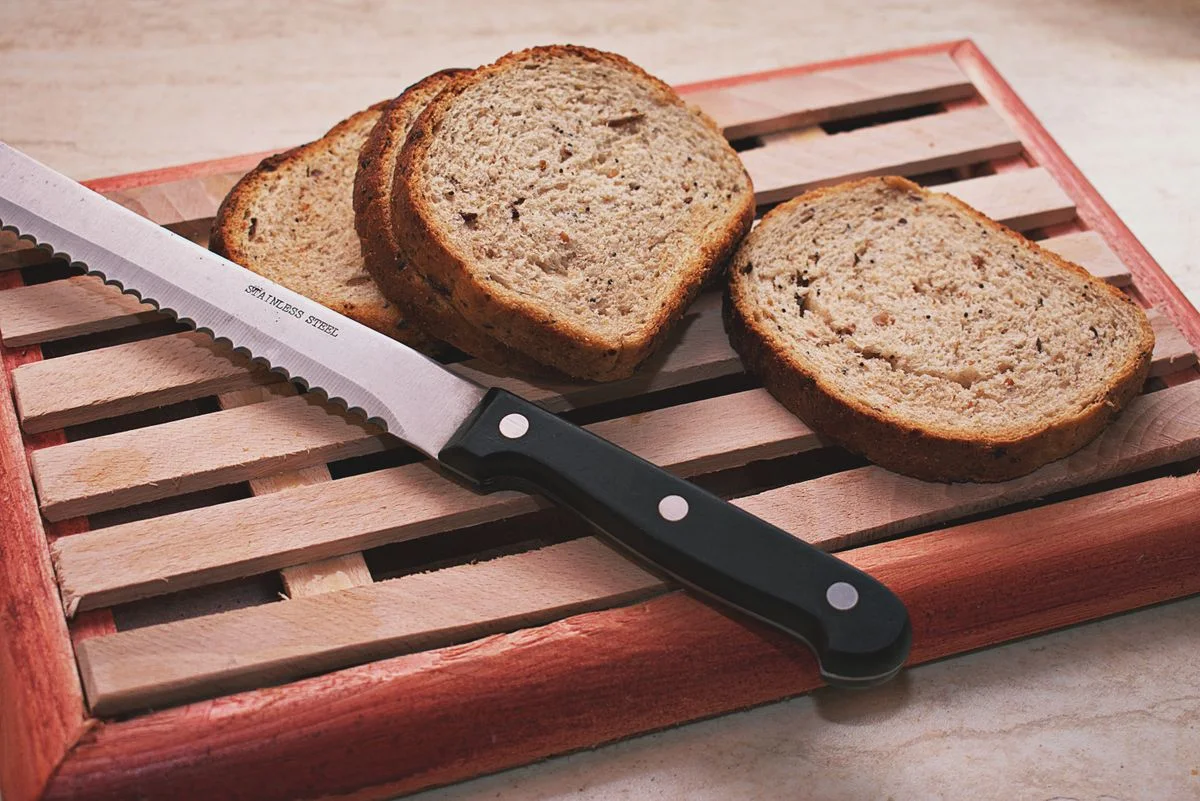
Bread knives are easy to overlook until a loaf has a thick crust or a wide, soft center. A suitable serrated blade should give you enough length for a controlled slicing motion on the bread you buy. Handle clearance, board size, and future maintenance matter too. Rather than choosing by tooth pattern alone, compare a few ordinary loaves and the place where you slice them. That keeps the purchase focused on a recurring task instead of a decorative matching set.
Match blade length to the loaf
Measure the width of a typical loaf, then look for a blade that leaves room for the slicing movement you prefer. An unusually short knife may require more small strokes, while a very long one may be awkward on your board. Consider both crusty rounds and softer sandwich bread if you buy both. The knife's total length also affects storage. A bread knife that cannot fit into your intended sheath or drawer insert needs a different storage plan.
Check knuckle clearance
A straight handle and an offset handle position your hand differently relative to the board. Look at whether your knuckles can clear the surface near the end of a slice. The preferred arrangement depends on your grip and the knife's proportions, so a photograph of the blade alone is not enough. If possible, hold the knife in a shop without handling the edge. Assess balance and comfort rather than trying to prove sharpness with an improvised demonstration.
Treat tooth claims with perspective
Manufacturers may describe pointed, scalloped, or other serration patterns. Those descriptions can help explain the design, but they do not establish a universal winner for every loaf. Read the intended uses and consider whether the blade has enough height and stiffness for your routine. Avoid buying several patterns before you have identified a problem with one. A clearly described blade from a maker that publishes care information is easier to assess than a long list of unsupported performance claims.
Check the maintenance route
Serrated edges need a different approach from ordinary straight-edge knife maintenance. Zwilling advises professional sharpening for its serrated bread knives; consult the instructions for the model you choose. Before buying, find out whether an appropriate service is practical and what a replacement would cost if service is unavailable. Hand washing and protected storage may be specified, but follow the exact guidance. A block slot is useful only if it fits the blade and protects the teeth appropriately.
THE USEFUL TAKEAWAY
Choose a bread knife for the loaves, board, and grip you use every week. Useful blade length and comfortable clearance are concrete reasons to prefer one design. Plan protected storage and suitable maintenance, and resist paying for several serration styles before a particular need appears.
Further information
Manufacturer and official references for the details discussed. Check instructions for the exact product you are considering.