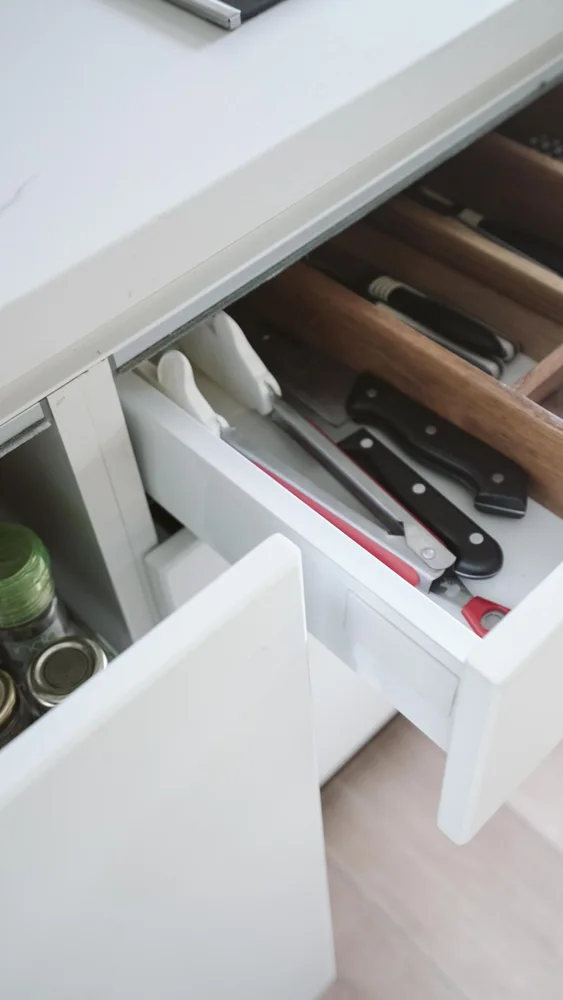
Drawer dividers are useful when they make objects easier to find and put back. They become less useful when every compartment is sized for an arrangement that changes a month later. Start with the drawer's actual interior and the items that move through it. Adjustable, removable, and cut-to-fit systems offer different kinds of flexibility. Choose the simplest arrangement that keeps everyday things accessible, while leaving room for larger objects and the way the drawer opens and closes.
Measure the narrowest interior points
Check width, depth, and usable height inside the drawer, including sloping sides, runners, and any fittings that intrude. An exterior drawer measurement does not establish organizer fit. The divider's top should clear the closed structure, and items should not catch as the drawer moves. Measure in several places if the interior is irregular. A removable tray can simplify comparison, but its outside rim may consume more usable space than a divider placed directly within the drawer.
Arrange the contents before shopping
Take out the items and group them by how you use them. Keep frequently retrieved objects near the convenient part of the opening. Check long or bulky pieces first, since several small compartments can leave no place for a large utensil or folded garment. A paper sketch or temporary cardboard arrangement can reveal the sizes you need. Avoid designing around a perfectly full drawer; a little unassigned space makes returning items and accommodating new ones less awkward.
Understand the adjustment method
Spring-loaded dividers, removable inserts, peg systems, and cut-to-fit strips behave differently. Read whether a product requires a particular drawer structure or leaves marks when installed. IKEA's UPPDATERA range includes different adjustment approaches, so the range name alone is not enough to establish fit. A cut-to-fit design may be adaptable once but less convenient after a major change. Compare how easily you can alter the arrangement with the changes likely in your household rather than the number of advertised configurations.
Make cleaning and changes easy
Drawers collect crumbs, dust, and small forgotten objects. Check whether the organizer lifts out and how each material is cleaned. Soft-lined products and rigid plastic trays may require different methods. If individual sections are replaceable, confirm exact compatibility. Keep the layout understandable enough that another person can return items without a diagram. A divider should support a simple habit; if it forces frequent rearrangement or turns every item into a tight fit, reducing the contents may help more than another insert.
THE USEFUL TAKEAWAY
Choose drawer dividers after arranging the contents, not before. Fit the actual interior, preserve space for larger objects, and select an adjustment method that suits future changes. An easy-to-clean layout with a few useful sections can remain convenient longer than a tightly packed grid of tiny compartments.
Further information
Manufacturer and official references for the details discussed. Check instructions for the exact product you are considering.