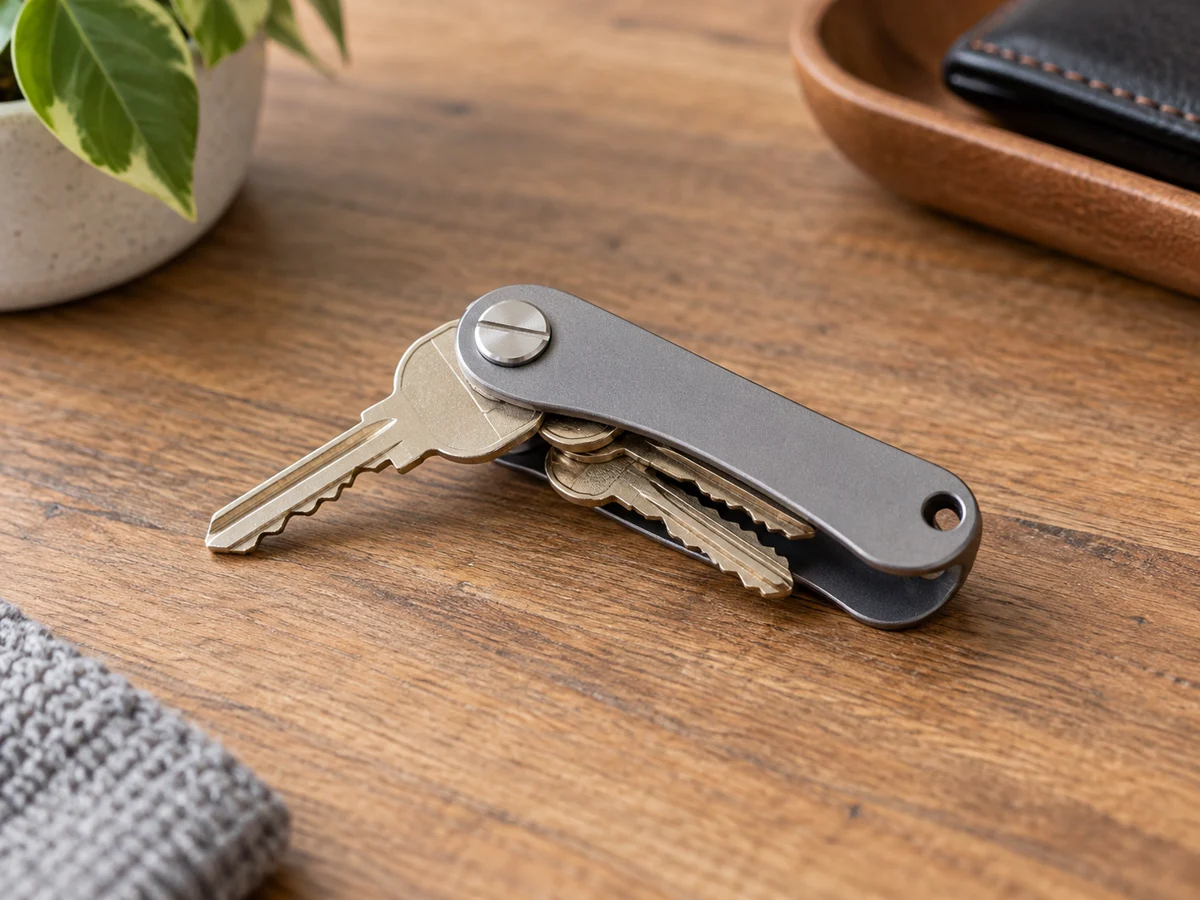
Key organizers promise a tidy pocket, but their usefulness depends on the keys you carry and the order in which you use them. Several matching flat keys are a different load from a car fob, access token, and oversized door key. A compact stack can reduce loose movement while adding a small step every time you need a particular key. Map the daily sequence first. Then decide whether a folding organizer, a simple ring, or separate groups would reduce friction.
Check every key rather than the total count
Measure the length, thickness, and hole shape of each key. A product's maximum capacity may assume a particular thickness and an uncomplicated stack. KeySmart's assembly guidance describes compatibility with flat keys, making the exact load worth checking before purchase. Nonstandard keys, plastic heads, and electronic fobs may need an external loop rather than fitting inside. Ask whether spacers and extension posts are included. A quoted capacity is less helpful if achieving it requires a separate accessory purchase.
Rehearse the door sequence
Imagine arriving with shopping in one hand. Can you identify and unfold the right key with the other? Consider whether the organizer body clears the lock and surrounding door furniture. Keys used in sequence, such as a building entrance and apartment door, should be easy to distinguish. A tidy stack that must be examined under a hallway light may be less convenient than two recognizable keys on a small ring. Do not modify a key or lock to make an organizer fit.
Account for fobs and extras
A car fob hanging beside the organizer can remain the largest part of the pocket load. Measure the full assembly, including the connection ring or clip. Bottle openers, small tools, and tracking devices add thickness and weight; assess each as a separate purchase rather than treating accessories as automatic benefits. If a tracker is useful, check its replacement battery, charging arrangement, app requirements, and current support information with the maker. A mechanical organizer without electronics may be sufficient for ordinary pocket organization.
Read the adjustment instructions
Some designs use screws and spacers to set the tension of the stack. Check how adjustments are made, whether tools are supplied, and how the manufacturer says to maintain the fasteners. Too loose or too stiff can both make access awkward. Look for available replacement hardware and clear assembly drawings. If you regularly add temporary keys, an arrangement that is simple to open may be worth more than the smallest finished shape. Keep any unused spacers labelled so later changes remain straightforward.
THE USEFUL TAKEAWAY
Choose a key organizer only when it makes the complete daily key load easier to handle. Compatibility and access matter more than a large advertised capacity. A small ring or two separate groups can be better value when fobs and unusual keys prevent a folding stack from becoming meaningfully compact.
Further information
Manufacturer and official references for the details discussed. Check instructions for the exact product you are considering.